

Committing The Perfect Groovy Crime
Hide The Corpse | A VR Game Analysis


Something different this time. A VR game analysis!
Now, I write a lot of feedback documents and mock reviews for games in development as part of my consultancy work, but inevitably these tend towards technical bullet-point breakdowns rather than straight up media-style reviews. I’m always looking for opportunities to flex my keyboard and discuss games I’m excited about from a more personal point of view. And every now and again I happen upon some hidden gems that don’t quite get the sunshine and attention I think they deserve. Usually these are smart titles from small developers, who are doing interesting and notable things in terms of game design and their user experience. I thought it would be fun to combine these approaches and write a half-review, half-feedback analysis of a game that I think deserves more love, and share the results. Let me know what you think - hope you enjoy!
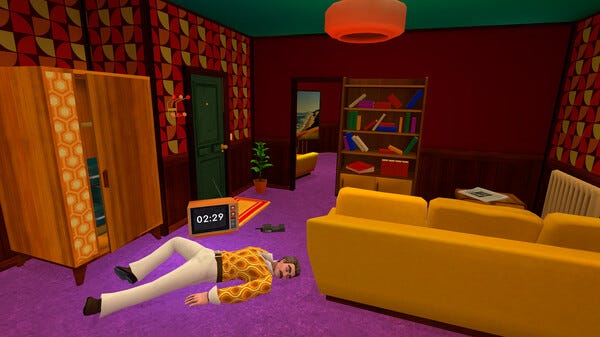
HIDE THE CORPSE
2024 PEGI-12 | Developed by Realcast.io | Published by HyperVRGames
Links — Website | Meta Store | SideQuest | Steam | PlayStation Store
Criminal Landscape
I accept that it’s quite possible that I’m just very weird with this, and that this declaration may get me on some government watch-list, but my favourite game to play on long distance car journeys for a long time has been to ask a simple question; “So, where would you hide a body? Go!!”.
Here’s the rules. One of the passengers gets nominated and gets two minutes to spot and identify a suitable body-concealing location out the car window, and then has to explain why it’s a viable, workable option, and what extra steps you might take to prevent the body ever being discovered. How the body became a dead body is irrelevant; this is more about how and where you’d dispose of a body at short notice if you had to. Pretend you’re just the clean-up guy if it makes you more comfortable. You’re Mister Wolff, or the Serial Cleaner, or one of the background cannoli-chomping heavies in The Sopranos. That leaves you with fewer moral complexities to navigate, so you can spend your two precious minutes concentrating on formulating a clever solution that will stand up to scrutiny and impress the other passengers with your ingenuity. It’s dark and perhaps a little bit naughty and controversial, but those ingredients can make a recipe for a fantastically fun time with the right friends. (PSA - probably not one to play with your uncool parents or too-young-to-be-cool kids, though).
But what if you’re wanting to practice your ‘waste-management’ skills, but don’t have a car, or some criminally-minded friends to play with? Hey, this is the future we’re living in now, and there’s an app for everything. US/French developer Realcast.io has provided an immersive spin on the same idea with their VR title ‘Hide the Corpse’, available now on Meta Quest, and soon to be sneaking into the crime scene on PCVR and PSVR2 too.
Profile | A Killer Concept
I started thinking about this when the game released into Early Access, and I still believe it 8 months later. Hide The Corpse (HTC) is simply a cracking concept for a VR game, and Realcast have done a great job presenting it in an appealing way.
Here’s the setup. You’re trapped in a fixed location, the police will be arriving within minutes, and you’re left to your own devices with a pleasingly robust ragdoll body and 6 pieces of incriminating evidence to hide, with a bonus if you clean away any fingerprints you leave at the scene. It’s a killer idea for a game, an especially good fit for the hands-on nature of VR, and the lightly comedic, slapstick tone fits perfectly.
First off, that game name is perfect. An all-time great game name in my book; succinct, immediate, simple to understand, perfectly descriptive, and intriguing. Plus, it feels a little bit naughty and controversial - see above! Three perfect words that describe this game completely — it’s an X-Statement as much as a moniker, I love it. Second, the game’s tone stands out as being very well judged, subverting an unthinkable IRL task into something that’s hilariously appealing and honestly feels borderline wholesome in the way it’s been presented. The team at Realcast have navigated the ethical and moral quandaries successfully by keeping the game blood-and-gore free, with no suggestion as to the cause of death or the perpetrator. It’s clean, not grimy; no incriminating viscera to clean up, no body parts to chop, no need for plastic sheets or rolling up blood-stained carpets. Instead, they’ve made sure that the puzzle revolves around covering up the evidence that a crime even occurred. The messaging comes through nice and clearly in the store presentation and marketing. Everything has been primed here for this to be a potential hit, they’ve simply done a splendid job here.
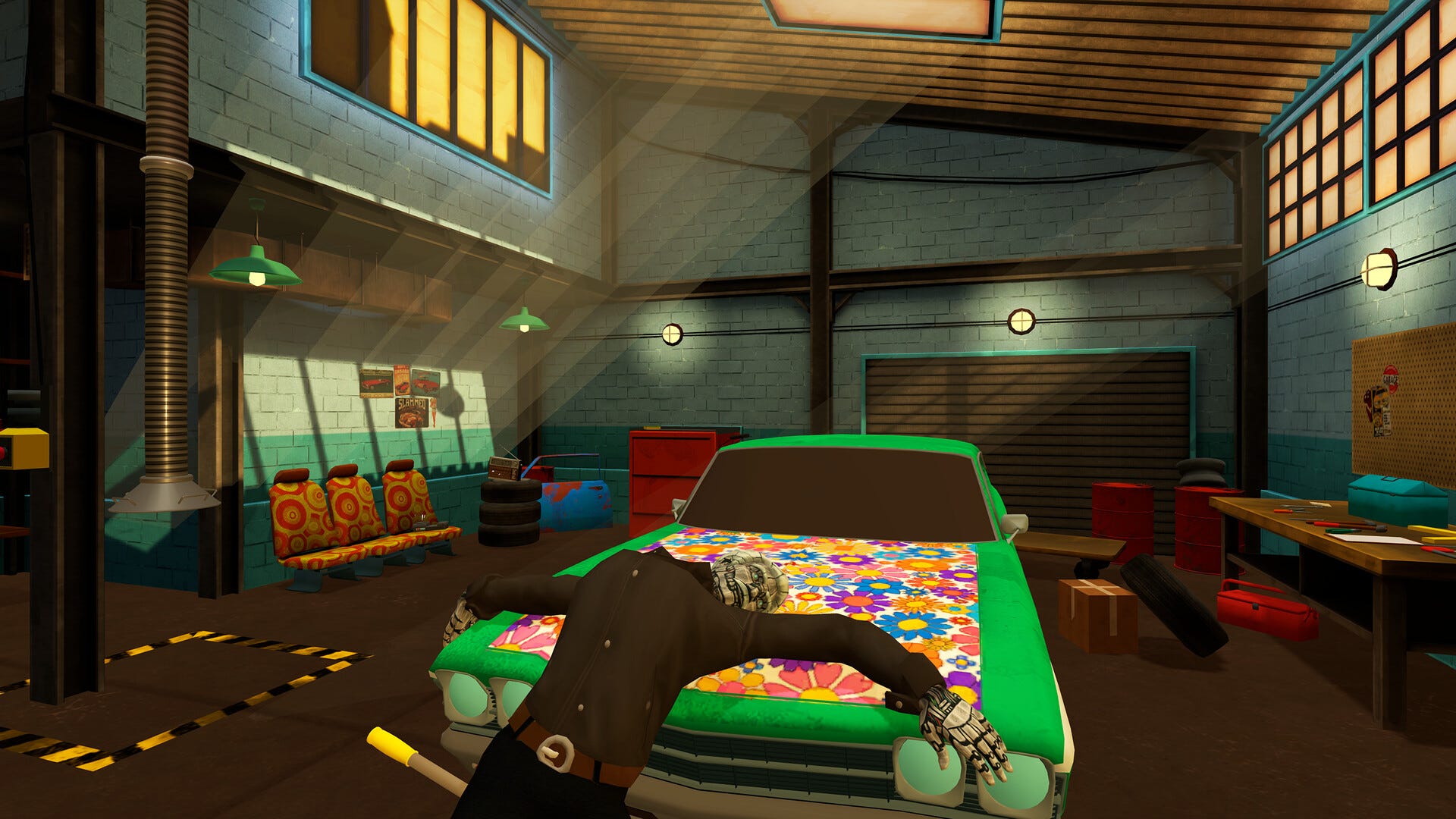
Speaking of presentation, this is a an immediately appealing game when you load it up. The environments look great, with enough flavoring in the details and textures to make each location interesting to poke around in and explore as you seek out those potential hiding places. The game exudes a funky, colorful 70’s US vibe with strong musical theming which works to build a peppy immediacy to the proceedings, but it does get repetitive. The music is integrated diagetically into the locations in the form of radios you can pick up, but annoyingly you can’t change station, adjust their volume or turn them off in-game, which would have been a nice suite of interactions to grant the player. Still, at least you can hurl them in a far corner or bury them with the body if it all gets too annoying.
The headline star of the show of course is Tom, the titular corpse, who looks great in his various outfits, and wangles about brilliantly, with some natural feeling jointing and movement that’s just the right side of rubber-limbed chaos and feels perfectly judged for the gameplay. He’s probably the strongest visual element, and handled like a real icon - the modelling, rigging and texture work on him are beautiful, polished and smooth in action, always looking good no matter what obscenely uncomfortable positions you maneuver him into. It feels like they made smart choices here to really go to town on him; he’s the centre of so much of your attention, and manipulating his body is the most consistently important element of the gameplay. It was absolutely the right choice to focus so much attention on the star of the show here.
Compromises | Corrupt Cops
There is one area that cheapens the feel of the presentation a little, though.
The game only features two other characters, a pair of Police officers who are dispatched to investigate the crime scene. You know they’re coming from the get-go, because there’s constant audio chatter from a police dispatch walkie-talkie in the environment with you, escalating expectation and tension through your four minute run. This audio is sadly always the same, but it’s super useful nevertheless as an aural timeline reference, avoiding the terminal anxiety that can come from watching precious seconds drop away on the game timer next to the front door. You get 4 minutes maximum. Whether you choose to open the door and let the boys in blue early entry (for max points), or run out the timer and get caught with them busting it open because you’re frantically trying to get a chest lid to shut but the corpse’s arm keeps plopping out, when that door opens your attempt ends. Pencils down, hands in the air; the test is over.
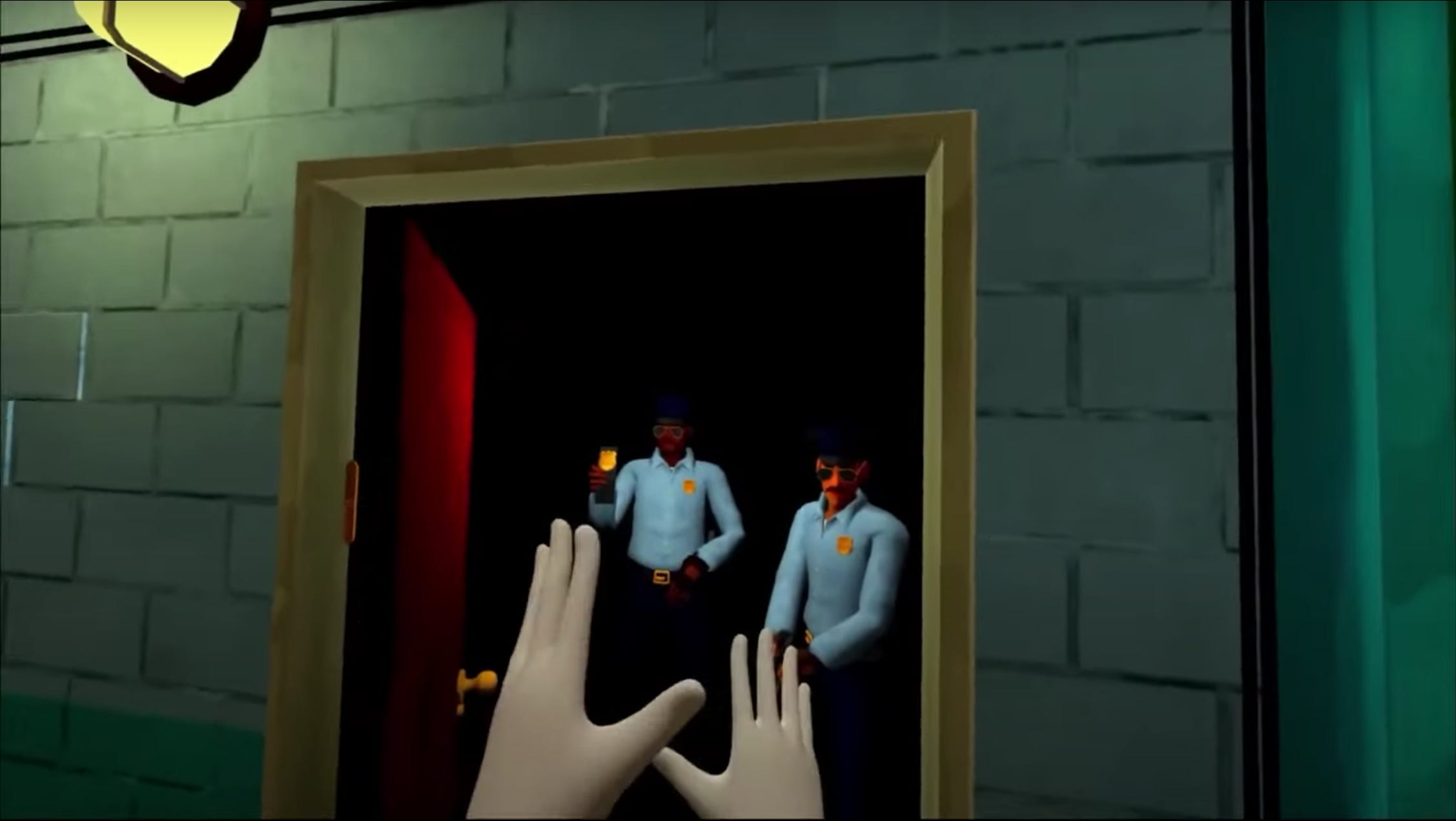
Unfortunately when those doors open, the cop models dissapoint. They don’t look as well-loved as Tom the corpse, feeling a little disparate in their design and proportions. It chips a little of of the veneer away from this climactic moment and the follow up sequence where they investigate the location around where you hid the body. These scenes are presented diorama-style as isolated vignettes against a black background, with the cops waving flashlights about and hunting for traces of your crime. Just what is needed here, but they always use the same animations, always go on just a little too long unless you skip them, and they sometimes use poor camera angles where you can’t see what the Cops are looking at, and so don’t get to enjoy the comedy of an errant arm flopping out in from of them (not that these moments affect their investigation, your pass or fail having already been decided at this point).
What is nice is that the cops sometimes enter all dressed up in thematically appropriate costumes for the level, which can be hilarious the first time you see them. But not for all the levels, though, which is a shame – the team might have committed to the bit here more fully. It’s a minor complaint. Otherwise though, this is a very attractive game for standalone, with a well chosen art style that runs well in the headset (tested on Quest2 and Quest3).
Structure | I Expect You To … Copy A Familiar Game
This game has a straightforward, casual-friendly structure : Hide the body, clean up your fingerprints with a squeegee sponge you’ll need find somewhere in each location, find the six pieces of evidence if you can, and open the door to let the cops in. Scoring-wise you’re working against the clock primarily, so efficiency is key. Six hiding spots to discover in each location, find and use enough hiding spots to unlock access to all six main locations. The better you do, the higher rating you get, and the more costumes you can unlock for the corpse. We do some crime, have a few laughs, dress a dead guy in some new duds, and we all go home and never talk about this again. Beautiful.
If you’ve played any of the ‘I Expect You To Die’ (IEYTD) series from Schell Games, they share a very similar meta structure. This game might initially feel similar in tone and style. I expected it to be only a small twist on that formula during my first play. But it becomes clear with time that it’s actually a broader interpretation of that structure in a lot of ways, and this very much works to HTC’s advantage. I figure that’s worth a bit of explanation.
IEYTD offers a variety of interactions and possibilities during play, but the main task is to figure out the golden path to completing your task and escaping, like a good 00-agent would. You learn mainly by linear failures – you trigger a booby trap or take steps in the wrong order and remember not to do that next time. Each playthrough gets you closer, you avoid the initial mistakes and hone in on the right steps, eventually you crack it, and the level is done. It’s a groundhog day trial-and-error loop that can quickly get repetitive if you can’t figure how to progress, and there’s little reason to return once you’ve puzzled/muscled it out.
IEYTD uses two main mechanisms to try and add replay value to counter this, but they never feel especially satisfying; there are challenges (e.g. defuse the bomb without using the wire cutters, beat a particular time etc) and there are secrets (e.g. escape wearing the foreman’s hat, find the hidden photo etc). Both of these will fill out your home environment with collectables (neat!) and can be tough to puzzle out (frustrating!), but it does serve to add some further play value to each scenario. Ultimately, though, to gain these you’re going through the motions of performing an escape that you already know how to do. It’s a completionist’s incentive, and better than nothing -- but it doesn’t present the same play value as, say, offering six different, viable ways to escape. Which is exactly what HTC does differently.
It feels like a bigger, more interesting proposition as a result. I’ve still yet to find every hiding place even after all this time (I refuse to cheat and look up a guide). There’s less of a collectathon angle here; the hub space reflects your progress by showing your scores at a glance, attached to Mister-Benn doorways, each reactively animating to your inspection in the style of the location it represents. It’s neat enough. A shame there isn’t more you can collect to flesh this space out, as IEYTD allows, but getting a good score, for each hiding spot on each scenario is compelling enough. My compulsive inner magpie isn’t crying out for more shiny things to attract me here. These two are in the same gameplay bracket for me, but body disposal is so often the choice I’ll go for when I want a quick bit of light hearted fun.
Oops. There’s a phrase that probably set an alarm flashing somewhere at GCHQ..!
Style and Tone | A Funky Kinda Viral Groove
Let’s talk about that tone and keep that comparison going for another moment, because it highlights the different design ethos for the two games. HTC is really enjoyable moment to moment in play. And it’s funny. IEYTD is a funny game, too, but it has a different approach, achieving it’s laughs through smartly-written scripted moments and witty character dialogue. But that can be an issue for groundhog-day games, as that scripted humour doesn’t stay fresh on repeated viewings. HTC skips the writing, but offers in it’s stead a physical comedy engine that provides emergent slapstick moments and unscripted dilemmas which just make this a funny game to play, hilarious to watch, and it doesn’t get stale nearly so fast.
And that’s probably a good way to compare the two; if you were to watch a video or stream of someone solving a level in IEYTD, you’ve seen the level narrative play out, witnessed the funny moments, and seen how to solve the puzzle. You just had the whole meal deal. It basically negates any need or desire for you to play it yourself. For marketing and social play scenarios, this is a challenge. HTC, I would argue, has most of its challenge and comedy emerging after you’ve identified your hiding spot. Now you’re struggling to get the body over there, fit it into the hiding spot, and make sure it stays hidden. Cue the comedy. It’s 10% solution, 90% execution, and this gives it a lot of replayability and emergent variation in how things play out. That also means it’s a good fit for viral sharing, and fun as a shared party-type game because everyone can screw up the same scenario in comically different ways.
There are nice surprises as you progress that I appreciated and don’t want to spoil, but suffice it to say some locations switch up core aspects of the gameplay in different and interesting ways. In fact, a large part of what I like about this game is that the design shows a playful sense of understanding user expectations throughout, such as luring you into obvious solutions that turn out to be traps and time wasters, hiding spots which get progressively trickier to identify, or failures that happen in a way you should have seen coming, but still make you laugh. Again, no spoilers, but it culminates in a final level where you’ll absolutely struggle to identify any workable way to get rid of the body on your first few tries, tempting you to improvise some hilariously dumb solutions. It feels like a game where, whatever genius idea you think of in the moment, the devs have already thought of it and provided for it.
I love games that pull that off well, because it keeps you effortlessly immersed and delighted, and it shows an accurate understanding by the developers of how their players will actually behave, and what they’ll try to do. Job Simulator is the king of this kind of predictive design in VR, of course, but please do share in the comments if you yourself have a personal favourite example that manages to do this well - I’m always interested to find more and maybe it’ll be a good subject for a future article.
Gameplay | Hiding A Crime Feels Fun and Unusual
I mentioned the corpse behavior before, and I’ll laud it again here. It’s the key to the gameplay and the emergent fun, and it feels very well judged. Pulling the body about and manipulating it is hilariously awkward, but it all keeps on the right side of videogame plausibility. It feels like a lot of attention has been directed here, ensuring the corpse moves smoothly and believably through the environment without snags or jank. No matter what ridiculous and compromising tangles you get yourself and the corpse into while trying to stuff him through a cupboard door or hoist him into a chest, the plausibility of these Weekend-at-Bernie’s moments never cracks or breaks. I’ve never once had any of the body physics go crazy on me; no trapped limbs, no parts getting stuck in a wall, no crazy physics collisions that would see limbs pinging off at ridiculous speeds or stretching like Reed Richards. It's been iterated, tuned and polished until it behaves as expected, 100% of the time.
That’s super important because once you’ve figured out a hiding place (there are six to discover in each environment and they become increasingly novel, secretive and unusual as the game progresses), the second half of the puzzle is how to get the corpse over to the location and into the hiding spot quickly and efficiently.
Sometimes it’s a case of just dragging it along the ground, other times you’ll have to lift and carry the body and manipulate it to get it into the right position and orientation. Angling an elbow or knee just right when you’re hiding it might mean the difference between getting away with the perfect crime right under the cops noses, or seeing an errant body part flop back out of it’s hiding spot seconds after you’ve walked away. Everything has physical properties, and it’s easy to cause an almighty mess along the way that you’ll never have time to clean up. I think it’s delightful that the gameplay delivers to this level, you’re never 100% convinced you’ve done all that you can, always leaving some micro-worries in your mind when you open the door to the police. Handling the body quickly and efficiently becomes the true soul of the game once you’ve figured out where you want to take it. Sometimes potential hiding spots are filled with contents you’ll need to clean out first to make enough room – but that makes more mess and slows you down, which is not ideal, because a fast speed nets you big points towards your final score and rating. Those are interesting variables that create organic decision spaces. In desperation, with the cops pulling up outside, every decision gains importance, and this creates the exact sort of drama you’d hope to find in a game like this.

As you can see in the GIF above, the developers have implemented reliable physics modelling and an interesting weight solution, which work great together. At first I didn’t even think about the mechanics of the solution, because objects just felt naturally heavy and bulky to interact with - easy to lose grip if you pull too hard or too fast, better to use two hands rather than one. It’s a compliment to how natural this feels (at least to someone who regularly encounters such systems in VR) that I didn’t particularly notice the visual feedback indicators on the hands for the first minute or so. You can see them above, your virtual hands turning blue and stretch away from your controller positions like a rubber band. The further away they are from your actual RL hands, the less grip you’ve got. Smooth movement and keeping your RL hands close to your virtual ones affords you more grip and better manipulation. It’s not the first use of a system like this that I’ve encountered for suggesting weight and grip, but it’s probably among the best implemented. Those newer to VR might find it a little odd, but once you’re used to the feel of the body manipulation, you may find the visual feedback becomes a useful support rather than a crutch.
It's not just the body you’ll want to hide though – each attempt also seeds six pieces of incriminatory evidence into the scene in random spots. These are all funky Tom’s personal possessions – wallet, lighter, comb etc. – and will deduct points from your score if you haven’t found them, grabbed them, and hidden them. They’re small, so you can chuck them behind furniture, into a cupboard or on a high shelf out of sight, but finding all six while hiding the body and inside 4 minutes can be tough, and then each takes precious more seconds to grab and dispose of. If a throw goes bad or it falls out of the hiding spot, you’ll wrestle with whether to go sort it or just hope you get time later (and you can remember where you saw it). It’s simple but it works well to inject some snap decision-making moments into the timed gameplay and adds scoring depth to the final result. However, this aspect isn’t really explained well in the onboarding, so there’s some trial-and-error to figure it out. As a design choice, the game only lets you carry 1 item in each hand at most – there’s no pockets or inventory or carrying them in a box you found, so this adds another interesting efficiency wrangle. The hiding criteria confuses for a while, too, because they can be hidden anywhere out of sight to qualify, but what counts as ‘out-of-sight’ feels nebulous. It would be great to see a static shot of each missed item in situ during the scoring sequences so the player understands where they went wrong hiding them.
Comfort | Investigating The Body
Considering user comfort, there’s a few factors that may be significant for some users.
Firstly, if you’re an older or less able-bodied serial cleaner, there’s a necessity to play standing, and you’ll need to physically crouch to pick up objects off the floor, or crawl into low spaces, hoisting the body with you. It’s not a workout, but you’ll need to use some mobility to play. Playspace-wise it’s been designed to work perfectly fine in a small area (even static), but the more space the better, as is usual with VR.
The game plays entirely through stick movement, with no teleport/blink movement (which just wouldn’t make sense for this gameplay). The travel speed is kept relatively slow during normal movement and needs to be slower still when moving the body about or else you’ll lose your grip, but this dragging motion can sometimes resolve into a slightly stop-start movement in practice, which feels realistic, but motion sensitive users might be bothered by. And because of the kind of work you’re doing in your criminal activities, you’ll also be spending some time moving backwards and watching objects or the body while dragging them, which can also represent a discomfort trigger for some users. There’s options for smooth or snap turning, blinders/vignetting, and head or controller-based steering, depending on personal preference.
Overall though, if you’re comfortable with stick movement at an average walking speed in VR (with levels designed sympathetically to this movement speed), you’ll likely be fine with this.
Final | Cleanup Details
I’ve spent a long time with this game, and it’s stuck with me. I first played Hide the Corpse in early access around 10 months ago and was impressed back then, despite the early jank. The final release was something I got increasingly excited for and bought day one, has been something I’ve kept returning to on Quest 3 ever since. I still find myself coming away impressed. It’s definitely my kind of game for a quick half hour play; funny, surprisingly challenging, and always with scope for you to improve your time and technique. Getting ‘S’ ratings is extremely demanding, but if you’re like me you’ll want to do it just to see what costumes you can unlock to dress Tom in. But mainly, it’s still for the fun of playing, even after all this time. I’m pleased to have been able to give it a bit of a shout out here, I think a lot of people will really dig what it’s doing. It’s just too much fun to let it fade into obscurity.
I’ll be genuinely interested to see how the PSVR2 and PCVR versions shape up, especially the possibilities that more advanced haptics offers. If it’s enough of a step up experientially, I’ll probably upgrade my copy of this, as it’s become a real favourite. However, the Meta Quest version is perfectly great as-is, with a well-deserved 4.6/5 stars on the Meta store at time of writing, 4.5 Stars on Sidequest, and I’d recommend it heartily.
And as a bonus, it comes free with thirty six absolutely splendid and fresh new ideas to keep those long car journeys from getting boring.
Until next time,

Jed
Jed Ashforth has been working in the games industry since 2002, and working with VR, MR and AR apps since 2010. He has too many headsets and not enough time. If you’re interested to find out more (or even bring him on board to help you) you can reach him, and check out more of his work and articles, at www.realisedrealities.com.
This here Realised Realities newsletter hopes to one day grow up to be a responsible reader-supported publication, but for now put your money back in your wallet / pocket / purse / sock / Swiss holdings account: it’s no good here.
To receive new posts and support my work, make sure you’re subscribed, and please feel free to share this newsletter with anyone you think might dig it. Seriously — that would be awesome.