

Remembering Rockband VR
The Way the Music Died

Everyone has a unique music journey. We have each of us explored many wide and varied musical landscapes in search of those songs and bands and pieces of music that speak to our heart. If we were to draw on a map where we each go on that journey, the genres we explore and the roads we take from one song to another, the trips we take to explore neighbouring genres and bands, and the shape of the musical landscapes you explore, it’s a safe bet that your map would be unique and quite unlike anyone else’s.
Music discovery is a very personal journey, but one that is shaped by many external forces - friend recommendations, streaming algorithms, social media shares, live performances, or just catching a tune on the radio, in a movie, on a TV show or in an ad spot. And naturally, over time, video games have started playing a part in this.
In fact, a significant number of people, particularly younger generations, cite video games as a source of music discovery. A 2021 report by MRC Data indicated that 28% of Gen Z music listeners discover new music through video games. A separate survey by YouGov found that roughly 24% of gamers in the US discover new music through video games.
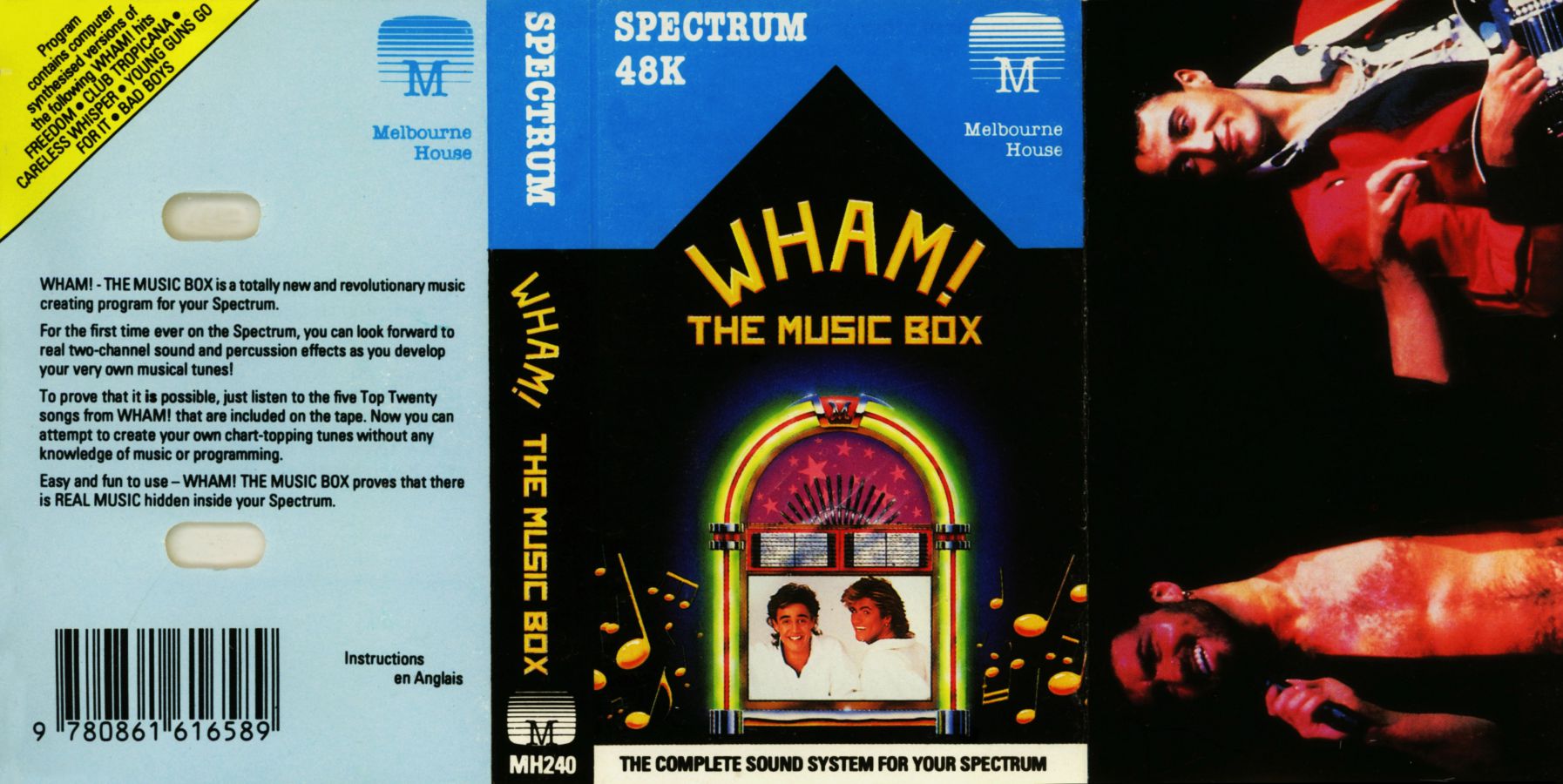
Discovering this made me feel a lot better about my own journey of musical discovery, because for a long time, music and rhythm games have been a significant part of how I often experience and discover music. Case in point: I blame the purchase of my first (and I promise only) Wham! album as a young teen in the early 80’s after playing around with Wham’s Music Box on the Sinclair ZX Spectrum. Dicking about with the songs as beeps and boops turned out to be much more entertaining than their music, and I quickly discovered I was not a Wham! fan.
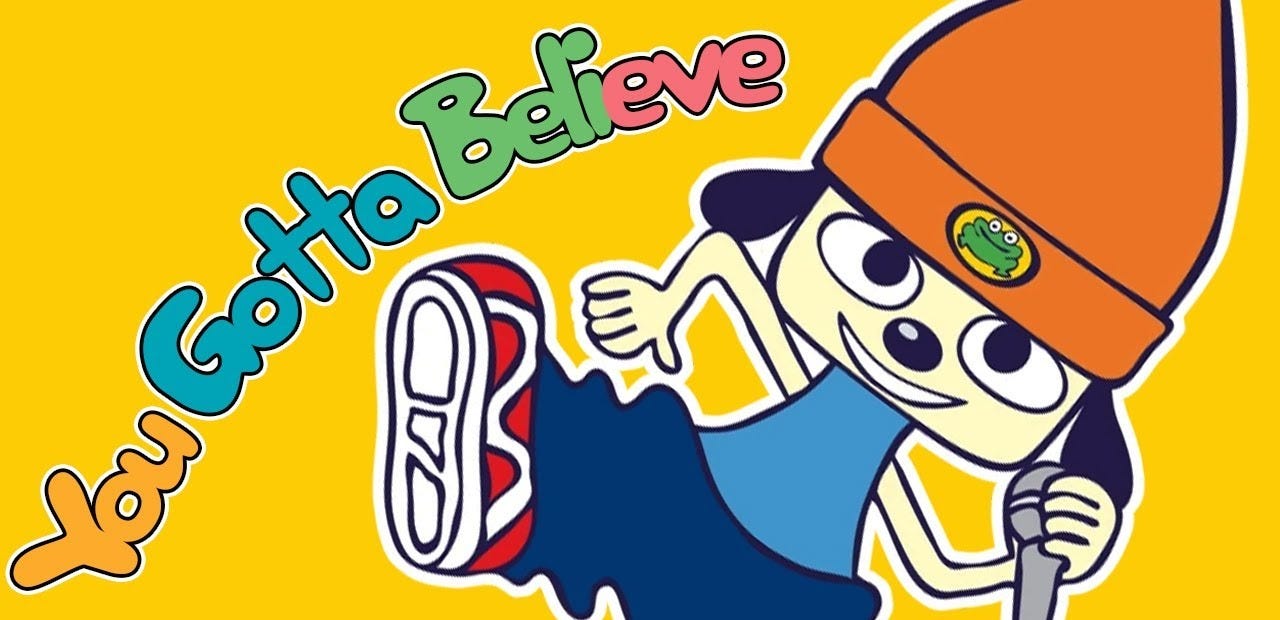
I have a special place in my heart for that early Dreamcast / PlayStation era when videogames were first wetting their toes with music gaming. My wife and I adored playing games like Parappa the Rapper, Um Jammer Lammy, Guitaroo Man, Frequency, Vib Ribbon, and many of the endless Dance Dance Revolution titles. We went hard into Samba de Amigo and still have 2 working sets - and until the VR version launched a few years ago (which is excellent fun), Dreamcast was still the only way to properly play it. We were pretty serious about the whole genre. I have IKEA storage boxes full of music game peripherals, from Donkey Bongos to Taiko Drums, DJ decks to Singstar Mics. We even bought 2 full arcade-size industrial metal dancemats, which are still clogging up the attic to this day. Sadly we’re not so hardcore as to still have a working PS2 setup to plug them into. 🤷
We loved DDR for exercise, and I believe dancing games influenced and improved my actual IRL dancing skills tremendously. People watch me dance with a look on their face I choose to interpret as awe and admiration. My feet sensibly spend most of their time as far away from my brain as they can get, and somewhere in that gap, rebellion brews. When the right piece of music starts they launch into a unique fusion of hopscotch and Riverdance at 150 BPM - regardless of the actual tempo of the song, and without a care in the world about what the upper half of my body is doing, or how this makes me look. I gave up trying to tame them years ago. For better or worse, my dancing feet are simply cursed with an ingrained DDR muscle-memory that is going to last a lifetime.
Intro done, let’s get into the verse. One fine day two decades ago Guitar Hero stepped onto the stage and the rhythm action crowd went wild with excitement. (Hang on, it’s been two decades? Really…? OMG etc). For too long, I genuinely wanted nothing more than I wanted to be holding that magical plastic guitar. I was obsessed. I pre-ordered the game and shipped it out from the US to the UK on the day of it’s release in early November 2005 … and then waited and waited for the parcel to arrive. The wait was interminable. Every day was a potential Christmas, until it wasn’t. Two days before actual Christmas, I was hauling out the cardboard recycling bin to the kerb for collection late at night, popped the lid and saw a guitar-sized parcel sitting in about 6 inches of rainwater inside. It could have come any time in the previous 2 weeks, and I guess the delivery driver placed it in the bin to ‘keep it dry’. No card through the letterbox, ofc. I fished it out under a streetlamp. The box was a soggy mess but the rock gods had smiled on me - the guitar and game inside were undamaged. I fired it up at like 1 am (using headphones of course - you don’t have to be a monster to be a Monster of Rock).
It was, if you’ll excuse my use of Rock & Roll lingo, fucking brilliant.
So much so that I bought the game again a few months later when it had a UK release, just to get a second guitar to rock out with my wife and friends. When developer Harmonix departed the GH series in a mic drop moment and then revealed Rock Band two years later - adding Bass, Vocals, Drums and (eventually) keyboards - I jumped onto that tour bus with them, promised my eternal soul to Harmonix, and swore to never let the music die (and to this day I still play RB4 at least a few times a month and eagerly play everything HMX put out, so 🙌).
Over time thousands of songs were added to the RB library, I did my best to keep up, and my musical tastes expanded in a million directions. Despite the name, Rock Band didn’t just offer Rock. It had pretty much everything. I discovered old and new bands, genres, sub-genres and strange cross-genre mutations that I’ve been in love with ever since, and that I never would have stumbled upon otherwise. If music games had never progressed beyond Parappa the Rapper, instead of the deep and wide spectrum of music I now appreciate, I gotta believe that my musical palette might have been quite narrow and mainly involved cartoon animals rapping and playing the maracas. Rock Band gave me not just the button-pressing fun of previous music games, but also slipped in a broad musical education when I wasn’t looking, granting me some much needed credibility when I go to a pub quiz.
If you’re ever over at my house and ask to play Rock Band, I got the whole setup - full size drum kit, Midi Keyboard, Mics, stools and stands for everyone including backing singers, lighting, and around 2000 songs in my library. We had some brilliant parties. People would come for Rock Band nights and dress up and really throw themselves into the theatrics, and it was always amazing. We’d have battles between bands - our own band, Insanitary headlined by Lena Heady (I have no idea but I remember it being hilarious at the time) and Captain Shittyfingers (whose name needs less explanation) remained the unbeaten kings.
These parties went on a bit too late and a lot too loud and eventually the neighbours just started asking if they could join in too, and they became regulars. People would invite other people. It was just a great way to make new friends and watch normies who would never normally go to a party and play videogames (eeeeeuw!) let their hair down, join the rest of the group in embarrassing themselves, decide it was too fun to care, and enjoy a complete change of perspective by the end of the night. I suspect we caused a minor revenue bump for Harmonix with the number of people who went away having had a fantastic time, drunkenly chattering about plans to buy a console and pick up the game, before staggering up the street and falling into a hedge.
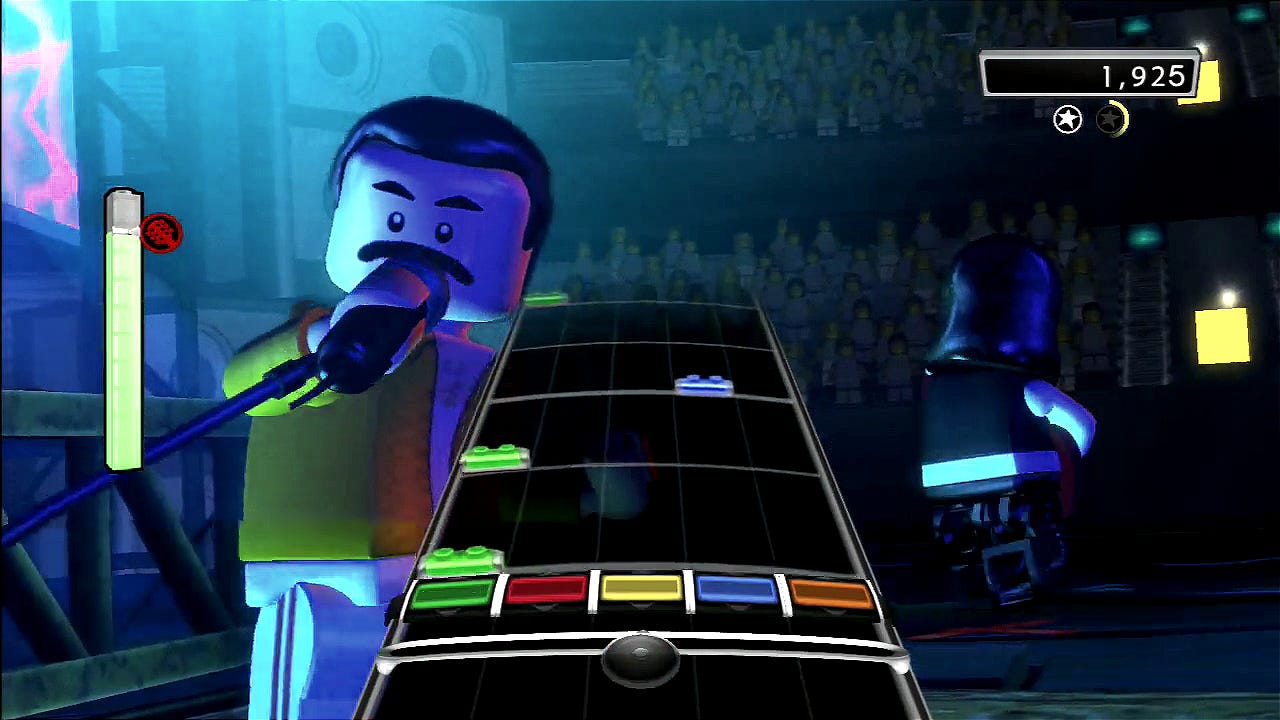
In time, Rock Band evolved into Rock Band 2, then 3, then 4, and along the way it took a few side tours (Beatles, Green Day, and even a truly bizarre Lego version from UK-based TT Games that one of my best friends worked on).
I collected the complete repertoire. For almost a decade I was the proud king of my local scene, and believed I had the most immersive Rock Band experience that was possible. But then all that changed.
At Oculus Connect 3 in October 2016, I got to play an advanced, private sneak of Rock Band VR for the first time. Maybe I’d snorted too many brown M&Ms from the complimentary candy carts that were dotted around the conference, but as good as it was, it was another six months before the full genius of the experience properly hit me.
At OC3, the great Shuhei Yoshida, PlayStation Senior Engineer Chris Norden and myself were treated to an early demo of Rock Band VR by eternally cheery Harmonix boss Greg LoPiccolo - a lovely musician-turned-CEO who completely didn’t remember me at all, even though he had flown me over to Boston for a weekend-long interview and treated me to dinner a few years earlier. I had been namedropping to Chris and Shuhei that Greg knew me well, and the guy then completely trashed my cred by blanking me. Again, probably he had too many brown M&Ms back in his musician days. That’s the most Rock & Roll explanation, and it avoids the existential torture of wondering if I’m just forgettable.
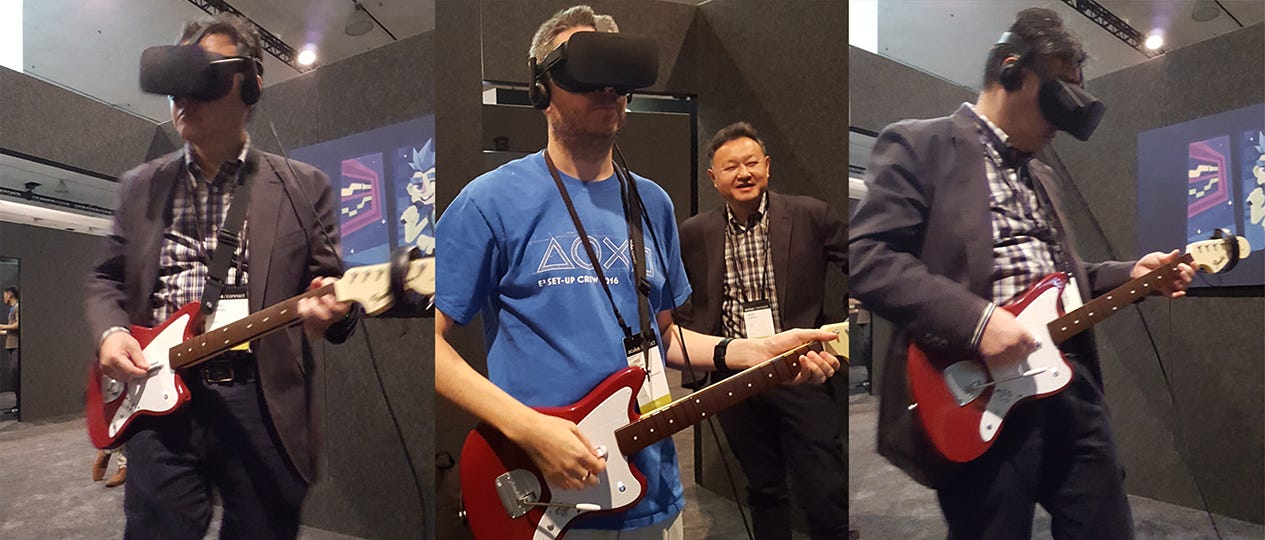
While boring business intros were made and connections forged out in the room, I got to don the headset and plastic guitar (which had an Oculus touch controller around the guitar’s neck for tracking) and try first as the seasoned player and VR guy, finger-fiddling through a RB standards like Joan Jett and Bon Jovi. And it was immediately brilliant. Great big ‘VR Wow’ first impression. I was looking down at the crowd in VR, they were staring up at me expectantly, and I turn and the band are on stage around me with the same expectant looks, I nodded to the drummer and it kicked off the song. The crowd went wild. Very very cool.
I could see that the game was an entirely different Rock Band, built from the ground up in VR. The familiar scrolling note lanes were gone. The focus here was much more on freestyle play. I had no idea what I was doing and the combined weight of virtual and gamedev audiences both watching me ensured maximum humiliation in front of my colleagues and the Harmonix team. Failshame aside, I was shocked that its main party trick was an all-new reimagining of the guitar system, rather than just transposing the existing game systems into VR. As thin a justification as that might sound these days, it really wasn’t uncommon with early VR games. In that landscape and time, Rock Band VR could have done the bare minimum and still easily justified it’s existence. But Harmonix don’t build games that way, and what they had created was something quite different, built around improvising chord patterns rather than following a chart of pre-determined notes. I could tell it was probably super clever and satisfying from the occasional moments when I accidentally made it sound amazing.
Yoshida-san went next, and by that point Greg had got into to delivering the full presentation spiel - and it turned out that not only did the system make sense, there was a ton more cool features to try out that I hadn’t known about, which was a real shame. You’ll hear about them later. I was angling as hard as professional courtesy could allow for another bash on the game, but we got involved in discussions until Greg’s next guests turned up. I didn’t get to properly experience the true genius of Harmonix’s VR implementation until the same day as the rest of the world, when the game launched to to the public on the Oculus PC store months later in March 2017.
Thank Hendrix that I didn’t need to wait months for a soggy parcel and a new plastic axe this time. The world had changed. We were now living in the future and I could just download the game and use my existing guitar. Woah. And as I started to play and explore, I realised there was a lot more cool stuff in there than I’d previously seen - not just all the stuff Greg had spoken about, but plenty of surprises that he’d never mentioned. It was a journey of discovery and wonder. I don’t think I got much work done for the next few days.
Cool As Kim Deal
So here’s a run-down of what VR adds to the Rock Band VR experience. I’m hoping to keep it concise, which is to say I’m going to try and avoid spending endless paragraphs gushing about how cool each of these things are. You already know I’ll fail of course. By now you all know what I can get like if nobody keeps a tight rein on me.
Wonderland
This is the most immediate and obvious change from the on-screen versions of Rock Band you may be familiar with. It’s all first person, with you able to see your guitar that matches 1:1 in size, position and orientation to the one you are physically holding IRL.
This is thanks to a special plastic doo-dad connector that’s tailored to hold a Touch controller tightly in place at the head of your guitar. I’d seen the controller was used for tracking at O3 of course but for all I knew they’d just superglued a Touch controller on the end of the guitar.
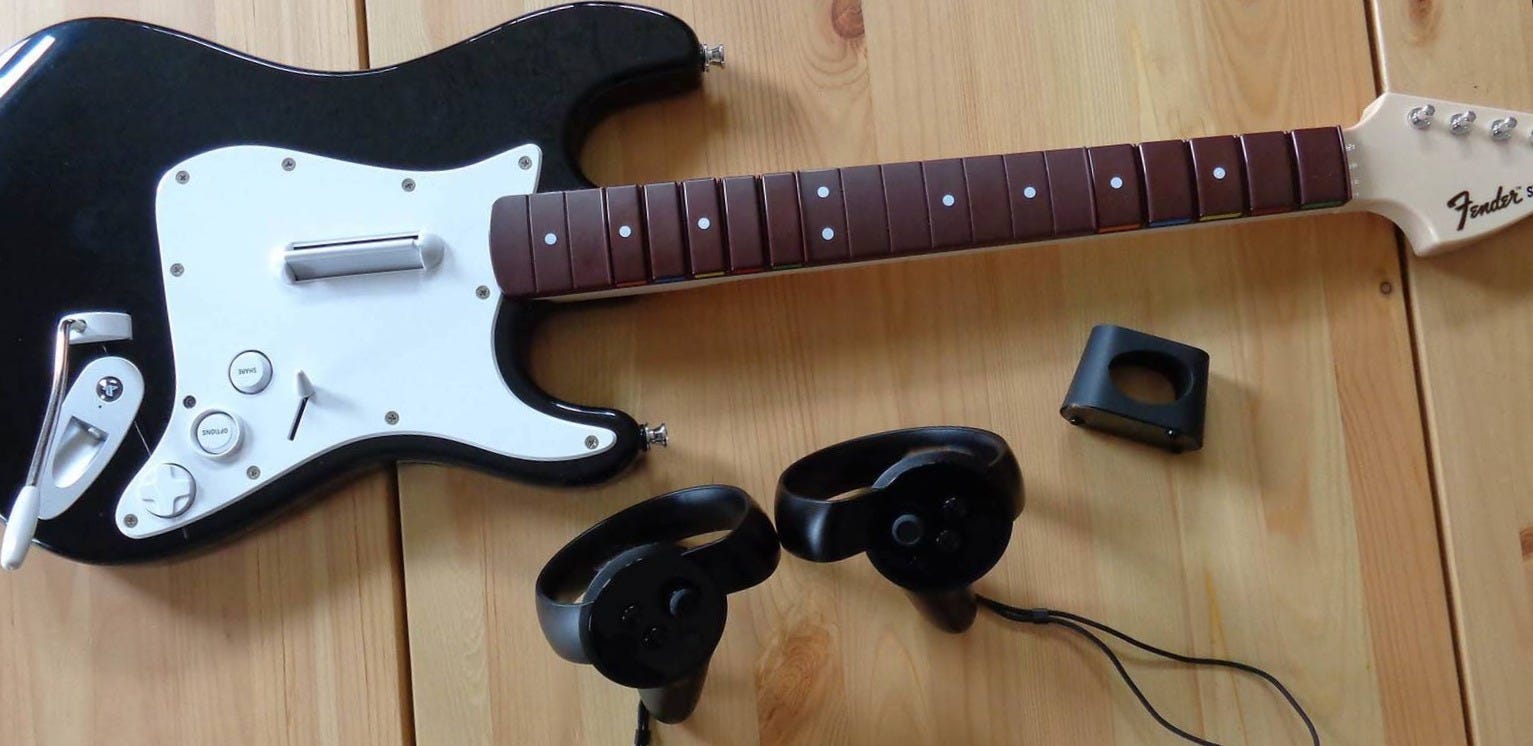
Oculus made sure everybody got one of these connectors, packed in with their Rift CV1. This was a bonkers move, but the only logical solution to get the necessary dongle in the hands of RBVR players - one downside of digital-only game sales that rarely crops up. It just reminds me of how much I miss the beautifully optimistic and generous ‘we can’t do enough for our customers’ attitude of early acquisition-phase Oculus, before billions, big business and Zuck reshaped them.
When you’re on stage and look down in RBVR, your body and hands aren’t shown to you, but this crucially means you can easily see what fret buttons are being depressed at any moment, and because it’s so spatially 1:1 accurate in terms of the guitar position and mapping what you see to what you feel without pesky fingers and limbs getting in the way, this feels like a superpower rather than a technical compromise. Most won’t even notice the absence of hands, and they’d only get in the way of seeing the vital buttons and their attached cues. Job Sim may have done it first, but it was the best technique to employ here in the context of the redesign of the guitar mechanics. There was naive criticism from some quarters that a believable avatar embodiment wasn’t being attempted. A decade later this is still a nut that the technologists haven’t fully cracked, and we know that a mismatched virtual body can shatter immersion more quickly than anything else.
I’ve seen a million faces and I’ve rocked them all
And of course you are ON a stage. There’s cables, amps, monitors, lighting stands and equipment cases all around you. Setlists are taped on the floor lest you forget what you’re supposed to be playing next. There’s scraps of gorilla tape, crumpled flyers and gum underfoot. The spotlights dazzle you, cloaking the audience in shadow - and there’s quite a crowd at even the smallest venue. Your first gig feels like a decent sized music club or student bar on a moderately packed night. It’s all very believable, and it helps reinforce the immersion in ways that I never even got close to with my much-augmented home setup.
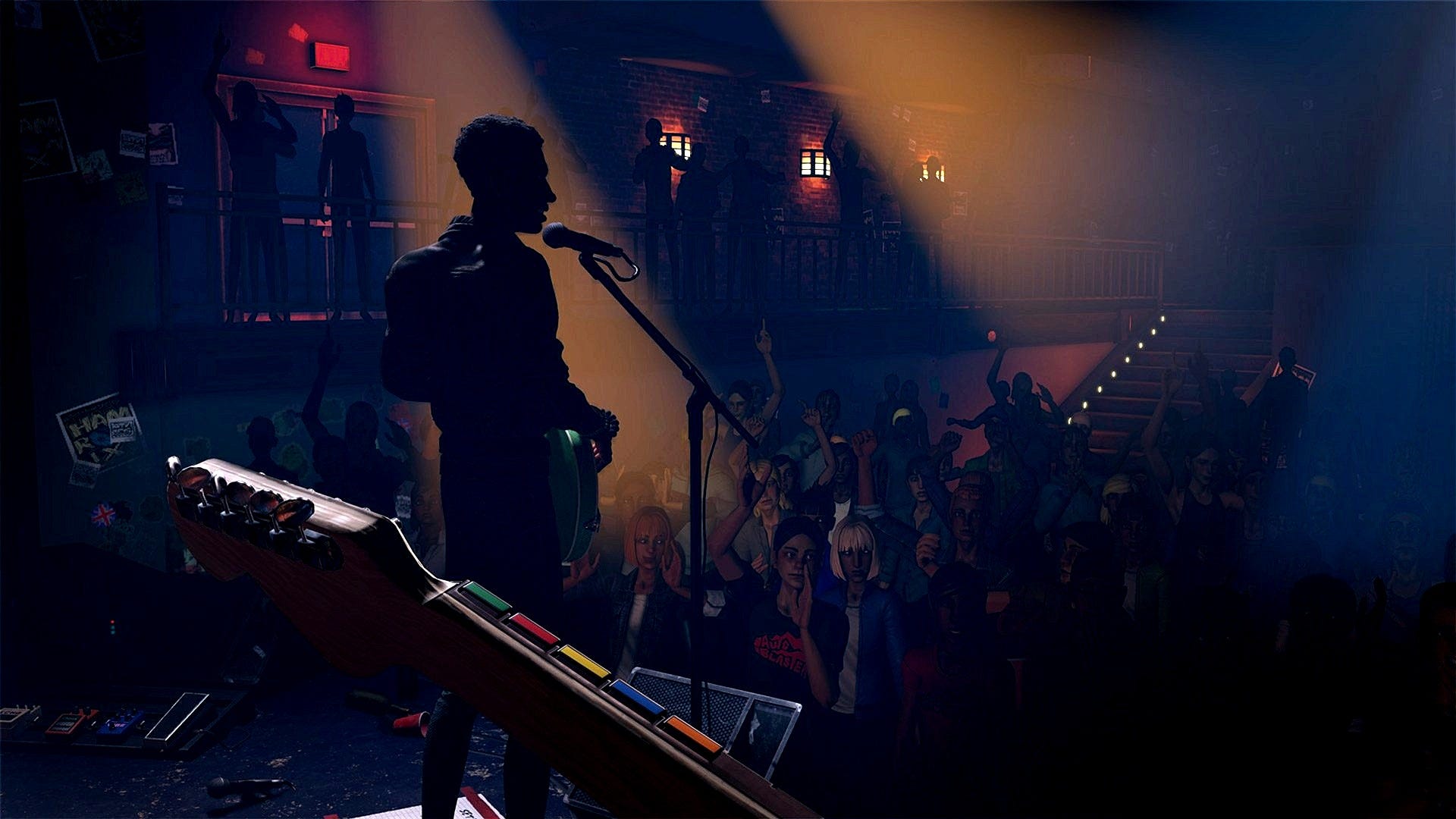
Now, I’ll admit I’ve never performed a real live music show (apart from one time I crucified the songs of Pontius Pilate in a school play of Jesus Christ Superstar when I was 10) but I’ve been up on stage in front of an audience many many times at various conferences and events. It’s a feeling I originally feared but I quickly found quite relaxing and addictive. I have no idea what that says about me as a person but I’d like to point out I am available for Lectures, Conferences, Ted Talks and Stadium Announcement roles. Put me up there coach. You know it makes sense.
Honestly, RBVR really captures that feeling of an expectant sea of faces staring up at you and waiting for you to deliver something good. Your band members are all looking at you restlessly, expectantly, and often a little bit annoyed. The experience nicely evokes that weight of anticipation and it puts you right in the moment before you even kick off the first song.
Band on The Run
Let’s talk more about the band members, they’re great. In the usual Rockband way, they’re kinda simple, cartoony and stylised in a way that’s become somewhat iconic for the brand. The art was never bleeding-edge and the design style was a decade old at this point, but they’re appealing enough and there’s a lot of personality in their animations. You get to create, clothe and name these bandmates however you like, assign them to roles and buy them new instruments - if you can afford to. The cosmetic options in RBVR are somewhat more limited than mainline Rockband, but there’s still plenty of them and the pricing economy, while simple, works well to make top-end gear desirable enough to work for and provides aspirational targets as you progress through the campaign as a rising music act.
So, after a decade of pretend-playing with Lena, Captain Shittyfingers and the other two, I quickly recreated them in RBVR, gave it a bit of the Elwood and put the band back together. Like some weird Tron spin-off, Insanitary were reborn into the virtual world and I got to step inside and join them - and it simultaneously kinda cool and kinda freaky to meet these familiar characters up close, locking eyes with me, and acknowledging my existence for the first time.
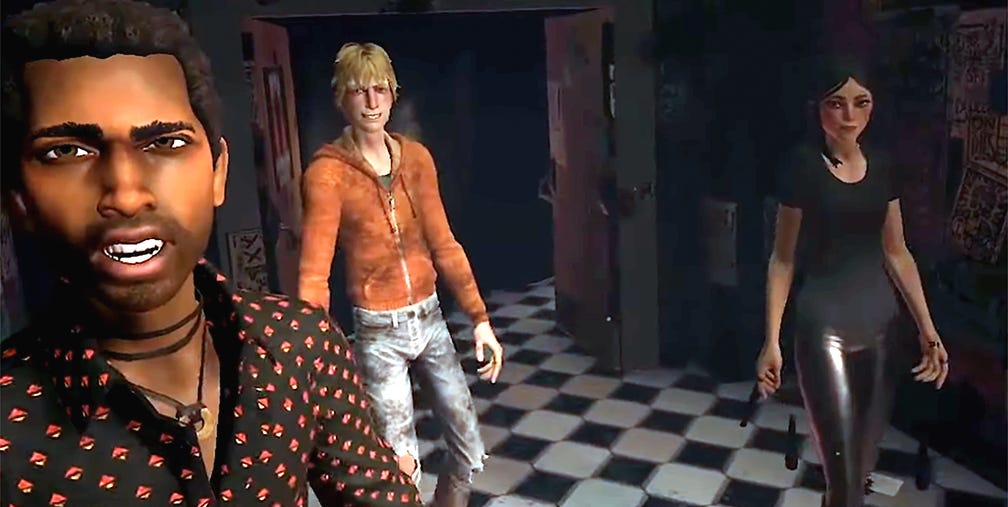
In flat-screen RB, the relationship between you as the player and the toon who appears on screen is fairly disconnected. When characters look at each other on-screen, they’re four animated avatars who connect to each other on-screen, but don’t really connect to you and your mates standing around with plastic instruments in your living room. But those same animations (and plenty of new ones) take on added power (and have you inferring additional context) when you’re embodied in that world yourself. This could have been a happy accident of the way the original animations were designed of course but the boredom backstage and the dirty looks when you screw up your guitar solo make the other members of your band feel very real in the moment. Like I say, it’s great.
Shine On You Crazy Diamond
I’ve got this far without mentioning a major caveat with RBVR - the only instrument supported is lead guitar. No bass, no drums, no keys, no vocals. This was explained by HMX community lead Josh Harrison at the time as ‘only the first go around’, noting to UploadVR the complexity of translating all the instruments, but that they made sure the tracks all really “really shine” on guitar. He’s not wrong, but it was definitely a disappointment for fans, and could have led to the game feeling like a step backwards to HMX’s Guitar Hero origins. And because you play the whole game with your hands busy cradling a plastic guitar, it could have resulted in a visually immersive but insular experience where the player stays glued to the spot and just gets to play their guitar. HMX recognised that, and rebelled against it in some brilliant ways.
Here are some examples;
Walk this Way | You’re not rooted to the spot. You get to teleport around the stage whenever you like during your set, so you can play back-to-back with your bassist, jam out with your drummer, or get face-to-face with the audience and take over as the frontman. And HMX sound director Steve Pardo really pushed things forward with a spatial positioning system to handle all the instruments and sound emitters. The team built a whole new ‘Venue’ audio system to reproduce the audio feel of stage performing, bypassing Oculus’ own Audio Spatializer in order to be able to fine tune the dynamic reverb at different locations around each venue. Moving around the stage gets you closer to hearing the raw instrument sounds rather than the mix you’re hearing back through the monitors. HMX were really early with this level of spatial audio treatment in VR, but perfectly pull off the illusion of moving around the stage and hear different parts of the song up close.
Do You Wanna Touch Me (Oh Yeah) | And there’s plenty of stuff to interact with as you’re roaming the stage mid-song. You can annoy the drummer by hitting his cymbals with the neck of your guitar. You can singalong and shoutout to the audience through singer’s microphone (your voice gets picked up thanks to the headset’s mic, it’s broadcast over the PA, you get some points for doing it, but there’s no chart to follow so while RBVR technically supports singing, it’s not in any way fully fledged - regard it as a free treat), and you big-up the audience energy by interacting with them - waving, jumping around, kneeling down on stage to play at their eye level - the more active you are, the more they love you. The more they love you, the more they’ll sing along with the song. It all works beautifully to encourage your inner Rock Star to come out of its shell and own the stage during the song.
Whiplash | Simple and obvious but… headbanging in time to the music is noted and rewarded. It doesn’t help you read the cues in the headset though, and if you do it too much your expensive cyberhat will probably fly off. Still cool regardless.
Holding On To Heaven | Where and how you hold and play your guitar matters. At our old RB parties, surrounded by real players, we’d always see wannabe virtuosos trying (and failing) to play their guitars in crazy ways for laughs, and we had names for them all - the Eddie Van Halen ‘Vertical’, the Keith Richards ‘Windy Miller’, the Jimi Hendrix ‘Above-your-head’, the Joe Satriani ‘Behind-yer-Back’, and the Pete Townsend ‘Squirming on Your Back on the Ground’, later renamed more concisely as the ‘Marty McFly’. Sadly the 2D game could never know you were doing this even while the IRL crowd were loving it, but in VR with multiple points of tracking (the head of the guitar, the headset position, and knowledge of where your hands are because of which buttons on the guitar you’re pressing) RBVR can convincingly recognise, acknowledge and reward any of these Guitar God antics with points and audience response. Of course, try it and you’ll no doubt fuck up your song royally, the crowd will boo and your band members will hate you, but just knowing there’s a version of that where you pull it off and the crowd might go knicker-flinging wild is too much of a temptation.
Let Me Entertain You | Harmonix have always had a beautiful knack for leaning into the playful, performative aspects of gaming (how else would we have ever got Guitar Hero in the first place, right?) and their absolutely brilliant attention to detail and smart use of the medium here elevates RBVR far, far above the VR band and guitar games (like Bandspace and Unplugged) that have followed in the years since. Absolutely outstanding and unmatched creative use of the technology here, and I struggle to think of any title that’s done it better anywhere in VR. It also has the distinction of being the only VR title I can think of where a peripheral is obligatory in order to play. Perhaps this is an avenue more games would have explored, and might again one day once the market audience is robust enough, as there are endless tantalising possibilities once you start putting different tracked objects in the player’s hands. There’s a fairly crowded aftermarket for optional golf club and gun stock peripherals that enhance VR play, but RBVR shows us things will really get spicy and adventurous when interaction designers can 100% count on a specific peripheral being used during play.
My Guitar Lies Bleeding in My Arms | HMX had continually evolved the guitar systems and play mechanics with each title they released. Their first Guitar Hero systems built on the foundations of Konami’s 1998 Guitar Freaks but added the whammy bar, basic hammer-on/pull-off (HOPO) techniques, FX selections to make the guitar sound different, and the mechanics of Star Power to reward good fretmanship.
Rock Band, as well as adding the other instruments, introduced the distinctions between rhythm and lead. Rock Band 2 refined the HOPO system still further to work more like real life. Rock Band 3 added an expansive Pro Guitar mode, with 102 button MIDI guitar support and a real six-string MIDI guitar option. The team had to dual chart every song separately, but it had unlocked a clear skill progression path to get dedicated players from pressing 5 coloured buttons to being actually play a real guitar if they wanted. A lot of work and surely one that would only appeal to a few hardcore players. But Harmonix are a team who have always seemed willing to do the extra work to understand their players and deliver unconventional but welcome features and touches that ensure they go away happy. If they ever offered me a job (I got close once!) I would jump at it in a heartbeat even today. They’re the real deal in terms of wildly creative and design-led studio.
So while it was unclear what, if anything, might be added to the guitar mechanics for RBVR, a purely guitar-based release, it was a controversial but not unexpected surprise that HMX took the opportunity to present a new and innovative approach that contrasted with the classic RB guitar mechanics.
So a quick aside. There’s a problem with playing a plastic guitar in VR when you think about it. You can’t see your fingers on the frets. The game can show you that one or more of the fret buttons is being pressed - and that’s a superpower for readability as I mentioned earlier - but you don’t know which finger that might be. Sometimes you do need to see your fingers. Back in the days before hand and finger tracking were a thing there was simply no way the system could be expected to accurately read - and reflect back to you - where your fingers were. On simple songs and easy difficulties, you may not run into a problem with this, but once the game has you moving your left hand around on the fret board, as a player you have to rely on feel alone to make sure your fingers are where they’re supposed to be. Mastering this is a well-known hurdle in traditional RB, and there the only problem is finding a convenient moment to look away from the TV screen and glance at your fingers. In VR, you don’t have that luxury. For beginners using a few buttons or past masters who have the muscle memory in place this isn’t a major problem, but it steepens the skill curve for everyone else.
And another consideration is that those scrolling lanes of notes that traditionally head towards you in GH, RB and co have downsides in VR too. One is that it would kind of ruin the immersion of being on stage - not only visually spoiling the believability of the scene, but also pointing your brain towards your existing expectation models of Rock Band, thus making it feel more like you’re playing a familiar video game rather than having a unique on-stage experience. Another is that the where and how of displaying those note lanes is a bit of a challenge too - the obvious idea of superimposing the chart over the crowd might introduce visual cues that suggest movement and cause discomfort and even toppling over for some users - and this problem will only get worse as the overlay is made bigger and more prominent in the user’s view. For a game that encourages you to be moving and leaping around the stage, that chart would need to travel with you.
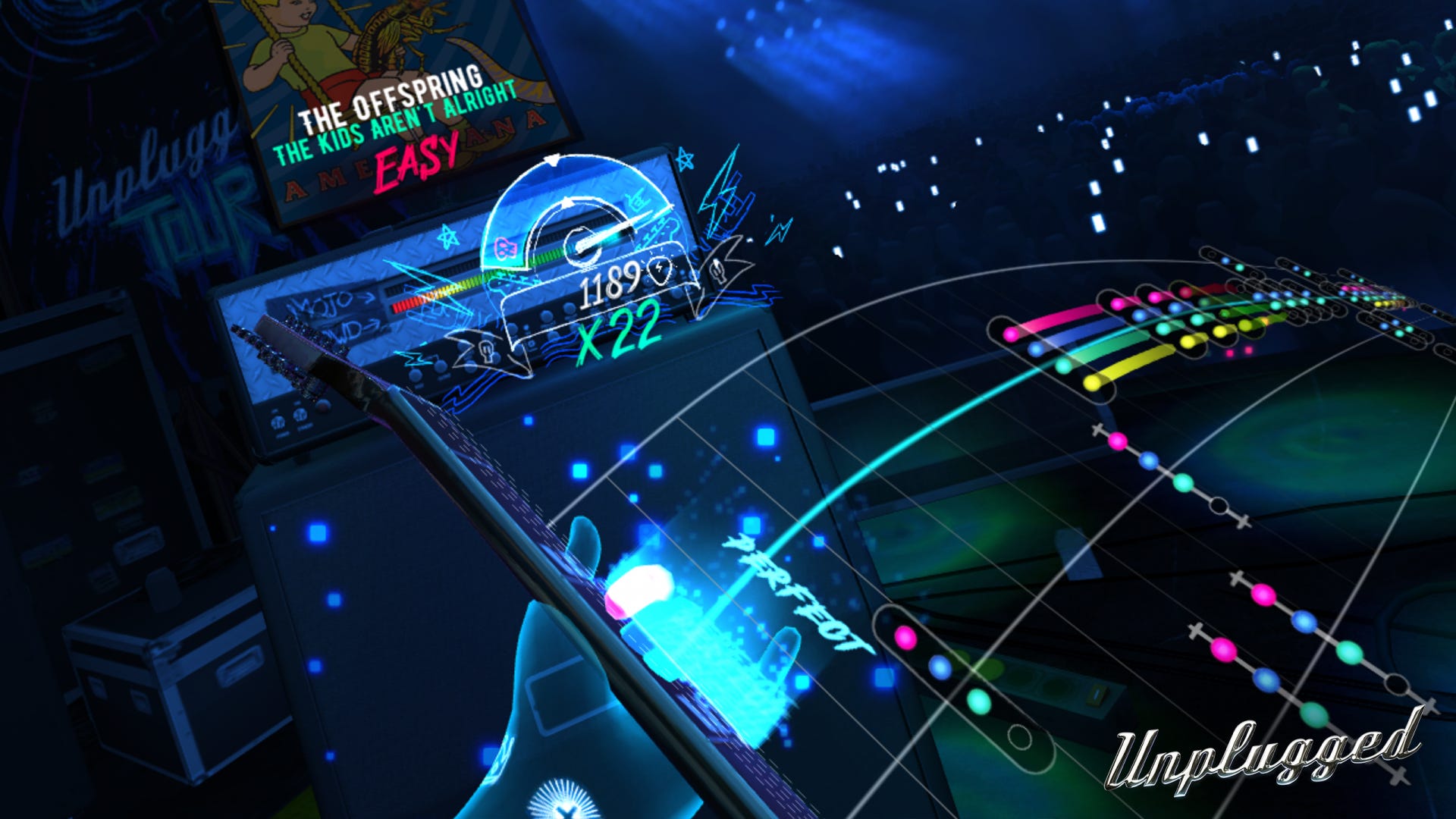
These days games like Unplugged have the note chart tied to the guitar neck, like some kind of endless scrolling scarf following your movements and carefully sized for visibility and legibility. There’s no suggestion from the note track that the player is in motion because it’s not locked to the same frame of reference as the stage behind.
Back then, with nascent knowledge and a lower pixel resolution to play with inside the headset, this would have been commercially riskier and technically more challenging than today. The path that HMX took for VR was a step in that direction, a smart and contextually apt solution that Unplugged clearly builds on. But it was fundamentally different from the existing guitar play fans were used to, and it caused some kickback from those expecting Rock Band But In VR(tm). Harmonix had that covered - there’s a freeplay mode that recreates the scrolling note charts in traditional style against a void. It ticks the box but I think for a lot of players they wanted a mix of the new VR presentation, and the traditional RB notecharts and mechanics, and for reasons we’ve discussed I just don’t think HMX saw a viable path to delivering that.
Look Ma, No Hands | The main mode instead presented players with a new system which straddled the web of offering believable stage presence alongside an ‘anyone can cook’ freestyle chord-based approach with a low skill floor and a high-enough skill ceiling. Even the most off-beat two-fret chord strumming from a first time guitarist could sound good, and in the hands of a seasoned RBVR player, the new system was versatile and tuned enough that amazing minutes-long Slash-level guitar solos could emerge like magic from your fingertips.
In a lot of ways, it was based on the innovations HMX had brought in with Rock Band 4’s optional freestyle solos two years earlier. This system is based around 7 Chords, combinations of fret buttons and forming distinct hand shapes which are relatively straightforward for your fretting hand to learn. It’s a system that scales very well to varied player skills, and the chord shapes will feel somewhat familiar to real guitarists. Anyone can start to play the game if they can learn to play 2 chords.
This is augmented with a ‘Chord Follow’ system, which sees you moving the handshape up and down the neck, and then switching between chords. Following the career mode of the game introduces these chord shapes at a steady rate, and is well judged to get players quickly feeling confident and eager to expand their repertoire. The recommended chord patterns are displayed both on a static overhead progress bar, for those looking out to the crowd, and down by the guitar, for those who are head-down bent over the strings, too lost in the epic solo they’re creating to look up. In career mode it pays (score = funds!) to follow the guidance, but once you’re pouring your soul into a soaring, improvised free flight, such trivialities no longer matter. And the ability to move around the stage becomes important in these spotlight moments. I’ve never once performed a solo from the back of the stage. And in the moment, neither would you, I can absolutely guarantee it.
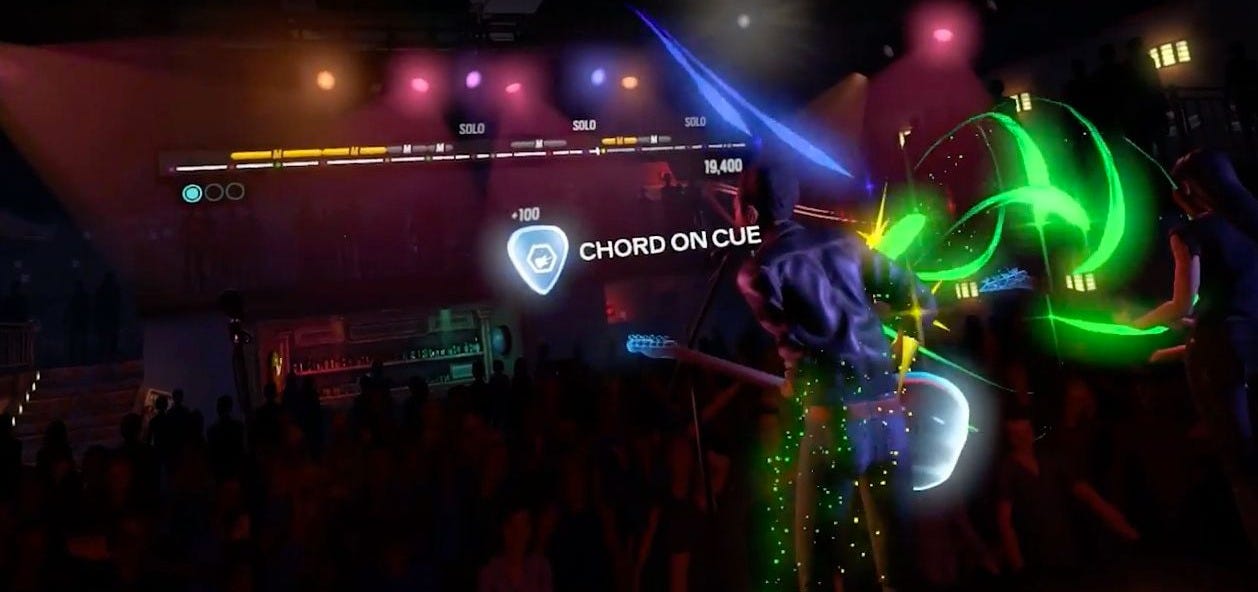
Don’t Rock the Boat (Baby) | The existing Rock Band ‘Wows’ are still in place, but augmented and elevated by the possibilities of VR. Star Power / Overdrive is still a delirious highlight and always best triggered at the most dramatic moments in the song, sending the crowd wild, and allowing you to flick the FX switch on the guitar to change tone effects and waft out different visual effects across the audience. Your whammy bar is still your best friend (and for engineering reasons still works contra to the real thing, the effects of pulls and pushes reversed, but probably saving them getting force-Skynnered out of too many plastic guitars 6 mins into the Freebird solo as a result). Standing near a speaker can cause feedback, which for some songs is absolutely a musical tool that’s worth exploring. It’s a system that’s very well suited to the performative, improvisational approach that Harmonix clearly want the player to explore - it’s more about understanding the structure of a song, feeling out it’s rhythm, and adding your contribution to it.
If the true measure of success for a music game is to make you forget the scoring and the ‘pressing buttons while the music plays’ reality, and instead immerse you in the fantasy that you’re playing an essential part in the performance, then Rock Band VR is inarguably the most successful attempt at doing that that I’ve ever played, and in all honesty nothing else has ever really come close for me. This game is the only reason I’ve hung onto my Rift and Touch setup for all these years, because the game just can’t be reliably played any other way. It’s a real treasure from less than a decade ago that’s already been all-but lost to history, and it’s something of a tragedy that more people can’t easily access it. It’s still as effective and overwhelmingly impressive today as it was at launch, and so many of it’s VR-first features still present as fresh and wow-worthy.
This is The End, Beautiful Friend, The End
Looking back retrospectively at the game, it’s clear to me that our expectations around VR games have changed significantly over the years. It was nominated for “Best VR Audio” and “Best Game Audio Article, Publication or Broadcast” (for Steve Pardo’s “Creating Rock Band VR”) at the 16th Annual Game Audio Network Guild Awards and sits at a decent 75% on Metacritic - only from 7 reviews, but I can attest that this was the general temperature across the non-MC reviewers at the time, too. All of the reviews commented on how immersive and polished it was, but often lamented the fact that HMX had changed up the core gameplay mechanics, while others complained that Rock Band was, at this time, fairly long in the tooth and had already drifted out of vogue. In aggregate: exactly the same thing again but can you also make it totally different please.
It’s worth remembering the time and context in which it launched - in 2016/2017 VR was white-hot: the most promising investment ticket in tech, the herald of the coming Metaverse that would change the world, and a hard left turn that was attracting technology and creative directors to explore this strange new land and see what they could do with it. It had assumed a position in the media as simultaneously an exciting source of technical wonder and a dependable target for gentle derision. The advancements made in the first few years as big studios and publishers (PlayStation, Ubisoft, EA, WB, Activision, Take2 and more) invested R&D time and money in producing AAA-standard content for the medium. Even though the results mostly fell in the mid and were often only bite-sized tasters, the quality bar they reached raised everyone’s expectations about what we’d be seeing next. The tech pushed out to explore in every wild direction and never seemed to hit a wall. It was a genuine new medium that had its own rules and shape to figure out. And there was so much funding money available. The brightest minds and deepest pockets coming together to pick a direction in the open blue sea and set sail with not much more of a goal than to creatively explore this new opportunity. It was a safe spend for anyone’s R&D budget. As a result, innovation was so rapid and commonplace in the medium that rapid forward momentum started to become taken as a given.
Honestly, I think the rapid blossoming of early VR created privileged expectations that today would seem unreasonable. We thought that there’d be an endless menu of new things to try, that we’d always be eating at the finest restaurants, and that every meal would taste this good. This could have been the case - there’s still a lot of reality and an infinite wellspring of fantasy that this medium can draw from - but as the money to pay for the ingredients started to go elsewhere, progress slowed. When Meta as the biggest player effectively turned back the clock by popularising standalone to become the premier format for the technology and brought new users onboard, those previous expectations were largely lost. Audiences learned to became grateful and for incremental increases in polish and performance, and to accept slow progress in exploring outside of established genres.
If you read through the features and attention to details that I’ve talked about above and thought they sounded just, like, way too cool, or if I’ve made you think that the package represented a generously rich and brave step forward for deep immersion, then I’ve managed to get across how astonishing I still find this game to be.
It’s amazing it was ever made. It’s amazing that it’s so full of love for the RB idea and for music as a creative artform. And it’s amazing how many user-facing VR details have been cleverly implemented to help you maintain deep immersion for the longest time. It’s a package full of firsts for the medium, many of which have never been replicated or attempted again since. And from a design point of view, it’s a simply staggering achievement. Comparing the experience of playing this to any other instrument simulation in VR - whether that’s a music game or a practice tool - I can confidently say that nothing else feels anywhere near as rich in its design and as VR-smart in its implementation. There simply hasn’t been an immersive game of this type that has aimed anywhere near as high IMO. And it’s not even close.
Surrender To Failure
It’s such a shame, then, that while RBVR’s time on the center stage was so gloriously bright, it was too short, and the audience it drew was too small. The game shipped with 60 songs in the base game, and another 21 were made available over the next couple of months as DLC. Harmonix had been regularly pumping out 3-5 newly charted tracks for Rock Band each and every week for years, so when the release cadence of the VR songs suddenly fell off a cliff, fans immediately began to worry for it’s future. All was quiet for a while and RBVR’s existence slowly drifted into memory as Meta left their PCVR aspirations behind them and concentrated on the new Quest line. The game received a few more patches but in 2020 Harmonix officially announced the end of support for the game. This seemed like it was probably because the Quest wouldn’t be able to run such a title (Q3 would still struggle massively today), and so the game, it seemed, had became one more victim of the bizarre inverse technological obsolescence Meta created when they jumped timelines and went all-in on lower-powered standalone.
In fact, it turns out the reason was starkly commercial. With a capital stark.
Commenting on Xwitter in January this year, after Meta started closing their first party VR development studios in what I referred to at the time as the Metapocalypse, Palmer Luckey defended Meta’s closures with an off-hand citation regarding Rock Band VR.
“People will point out that these teams did an awesome job and got awesome reviews from critics and customers alike - yes, and fucked up though it is, that makes the problem even worse. Some people will say "they should have just funded those developers as external studios rather than acquiring them, then!".
Yes, I agree, but hindsight is 20/20. Do you think Oculus expected to only sell 700 copies of Rock Band VR after spending eight figures to make sure it was ready and awesome for Rift CV1 launch, to the point of bundling the guitar adapter with every single headset? Of course not, but sometimes you learn what the world actually wants from you the hard way.”
I could fill another 6000 words right now reflecting on that number, but I think it speaks for itself.
An 8-figure development spend. 700 copies sold. The way the music died.
If you’ll excuse my use of the lingo again … I guess that’s just Rock and Roll, right? Pass the brown M&Ms.
Until Next time,

Jed
Jed Ashforth has been working in the games industry since 2002, and working with VR, MR and AR apps since 2010. He was part of the team that created PSVR at PlayStation, and has worked, consulted and helped on around 180 videogame and XR projects. He sometimes likes to pretend he’s an extraordinary Rock God while waving around a toy guitar. Most of the time though, he’s not pretending - it’s real.
He helps developers elevate their immersive and interactive experiences, both 2D and 3D. If you’re interested to find out more you can prod the button below, or you can reach him and check out more of his work and articles, at www.realisedrealities.com.
All of my illustrations and text - in fact everything in this newsletter - is achieved without the use of AI. I like writing, and I like doing graphic design. Call me human, but I like doing the fun bits myself.

Wow Jed. Props to your deep, deep love of the Harmonix lineage (that I was lucky to play a small part in) and this love letter and historical ode to RBVR. I hope Greg recognizes you now 😝